Finding parking downtown is hard enough without a disability.
Madison keeps it simpler than many cities: a valid, state-issued Wisconsin “Parking for Persons with Disabilities” hangtag or license plate unlocks designated spaces across the City’s lots and garages and a meaningful exemption at most on-street meters.
The details matter, and they are easy to get wrong. The hangtag does not make every space free, and the person it was issued to has to be in the vehicle. This guide explains exactly how accessible parking works in Madison, verified October 2026.
The City’s own accessible parking page always controls, and rules can change — check it before you rely on any specific detail.
What a Hangtag or Plate Lets You Do
The foundation is a valid, state-issued “Parking for Persons with Disabilities” (PWD) hangtag or license plate, issued by the Wisconsin Division of Motor Vehicles. It must be properly displayed whenever you park in a designated space.
The City’s rules treat the hangtag and the license plate the same way, referring to them interchangeably throughout.
Two rules catch people by surprise. The individual the hangtag or plates were issued to must be in the vehicle when it is parked, and again when it leaves the space. Borrowing a relative’s placard to run an errand is not allowed.
There is also a safety rule worth knowing: do not drive with the tag hanging from the rearview mirror. The City warns it can obstruct your vision and lead to a moving traffic violation.
Where the Designated Spaces Are
Madison places accessible spaces in every City lot and on the ground floor of every City parking garage. The State Street Capitol Garage goes further, with accessible parking next to the elevator on every level.
The City publishes the current count of accessible spaces per facility. As published in October 2026, the largest concentrations are in the State Street Capitol Garage (33 accessible spaces), the State Street Campus Garage (17), the South Livingston Street Garage (12), and the Overture Center Garage (11).
The smaller numbers run the other way. The Capitol Square North Garage has eight accessible spaces, and the Wilson Street Garage has nine. Among surface lots, the Buckeye and Evergreen lots each have two accessible spaces, while the Blair and Wingra lots have one each. The Wilson Lot currently lists none.
Elevator locations matter when mobility is the issue. The Overture Center Garage places its accessible spaces at the east corner near West Mifflin Street, the South Livingston Street Garage at the west corner near South Livingston and East Main, and the State Street Capitol Garage at the east corner near West Dayton and North Carroll.
The State Street Campus Garage has no elevators on its North Frances Street side, so use the North Lake Street entrance, where three elevators serve the garage.
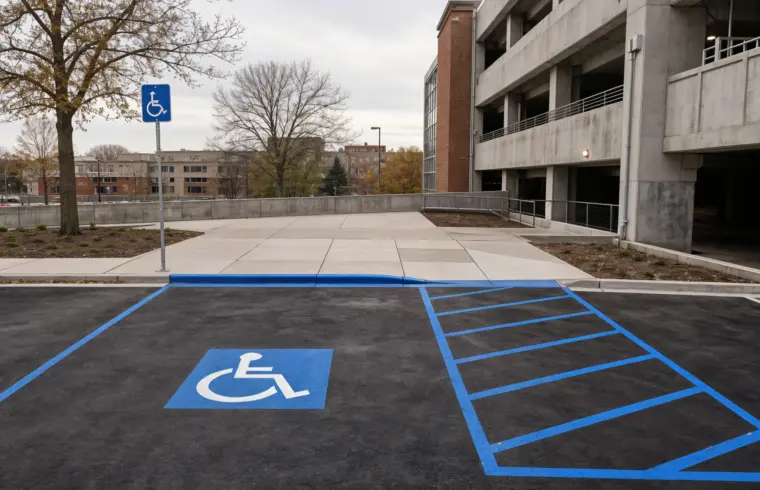
On-street, designated accessible spaces exist too. The City’s Civil Rights accessible parking page confirms a hangtag or plate allows parking in accessible spaces on streets. Posted signs at the space carry the most current restrictions.
How the Meter Exemption Works
The most useful part of the hangtag is the meter rule, and it has a specific threshold. A hangtag or plate exempts you from parking fees and time-limit restrictions only when parking at a meter with a time limit of 30 minutes or longer.
That means at a two-hour meter, you can park beyond the limit without paying. At a short, under-30-minute meter, the exemption does not apply — the standard time limit and fee both stand.
The Civil Rights page puts it plainly: the permit lets you use a 30-minute-or-longer metered space for longer than the time limit without getting a ticket.
Garages and lots work differently. Parking within the cashiered section of any City garage or lot still requires payment of the standard fees. The hangtag gets you into the designated accessible spaces, not free parking.
At cashier-operated facilities, you pay on exit through cashiers, pay-on-foot stations, exit stations, or a parking fee notice for overnight stays.
Getting a Hangtag or Plate
Hangtags and license plates for people with disabilities are issued by the Wisconsin Division of Motor Vehicles, not the City.
The disabled parking identification (DIS ID) hang tag is available free to people with an eligible permanent disability.
If you prefer plates, the DMV also issues disabled parking license plates for people with a permanent disability.
For a temporary condition, the DMV offers a red temporary permit that is valid up to six months and costs $6 each. The City’s parking office points to the DMV at 608-266-3041 (or the Wisconsin Relay Service at 711) for questions about obtaining one.
Accessible Parking at Home
Accessible parking is not only a downtown concern. If you have a mobility impairment and live in housing with a parking lot, the Fair Housing Act covers parking accommodations.
You may request a reserved accessible space near the entrance to your building, and a property owner cannot charge additional fees for that accommodation. The City’s Civil Rights office points to the Fair Housing Center fact sheet for the details.
Parking lots themselves must meet minimums. By law, a lot must provide at least one accessible space for every twenty-five spaces, and at least one of every six accessible spaces must be van-accessible. The van-accessible requirement is the one most often missed, since it calls for wider stalls and access aisles rather than just a painted symbol.
Reporting a Problem
If a lot is short on accessible spaces, a van-accessible space is missing, or someone without a valid permit is parked in an accessible space, the City wants to hear about it.
Contact Madison Parking Enforcement at 608-266-4622 or parkingenforcement@cityofmadison.com. That is the same office that handles accessible-space misuse on the street.
What Still Applies
A hangtag or plate does not suspend every other parking rule. Seasonal restrictions still stand — Madison’s winter parking rules (alternate-side and snow-emergency parking) apply regardless of a placard, so check them before the first plow.
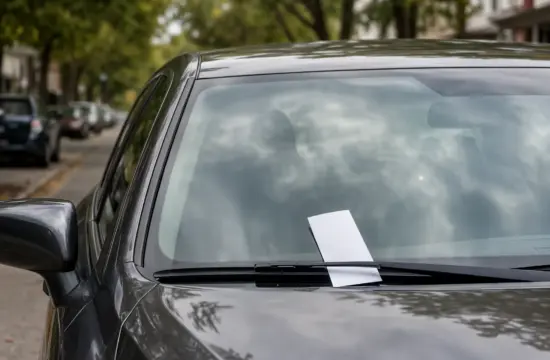
Misuse carries consequences. Parking in an accessible space without a valid permit, or using someone else’s, can produce a citation — the City’s parking ticket guide walks through how to pay, request a review, or contest one.
The short version is a simple checklist. Display a valid Wisconsin hangtag or plate, keep the issued person in the vehicle, use the 30-minute-and-up meter exemption, and expect to pay standard fees in the cashiered garages.
Quick Reference
Here is the whole rule set at a glance, verified October 2026.
- Display a valid Wisconsin hangtag or plate whenever you use a designated space.
- The person it was issued to must be in the vehicle when parking and when leaving.
- At a meter with a 30-minute-or-longer time limit, park free and beyond the limit.
- At a shorter meter, the normal fee and time limit apply.
- In cashiered garages and lots, standard fees apply even in an accessible space.
- Do not drive with the tag hanging from the rearview mirror.
- Get the hangtag or plate from the Wisconsin DMV, not the City.
For anything that changes, the City’s accessible parking page is the place to confirm.