Madison winters bring snow, ice, and a set of parking rules that exist for one practical reason: the City needs to clear the streets. Alternate-side parking, the Snow Emergency Zone, snow-emergency declarations, and sidewalk clearing duties all support that work — and they confuse newcomers, renters, and visitors every year.
This guide explains Madison’s winter parking rules as the City of Madison publishes them: when the season runs, how alternate-side parking works, what changes in a snow emergency, what violations cost, where to park off-street, and the snow duties that come with owning or renting property here.
The program is also under review. Madison tested a delayed-enforcement approach in 2025–26 and is phasing in further changes, so enforcement can differ from one winter to the next.
The details below reflect City pages verified in September 2026 — always confirm the current status on the City of Madison’s Winter page before relying on any single night.
The Winter Parking Season Runs November 15 to March 15
The City follows alternate-side parking between November 15 and March 15 each year. During that window, alternate-side rules can apply on any night, and parked cars must sit on the side of the street that matches the calendar date.
Enforcement is the variable. In 2025–26 the City piloted delayed enforcement: alternate-side parking was enforced only after the Street Superintendent declared the first general plowing operation or snow emergency. A “general plow” means every street in the City plowed curb-to-curb.
Once activated, the rules stayed in effect through March 15, though ticketing could pause during long stretches without snow or ice.
The City also stepped up enforcement of posted weekday daytime street-maintenance restrictions after snow events — towing included — and it is planning further changes, including a new notification system for 2026–27.
The Alternate Side Parking Program Updates page explains the phased review; because activation drives the rules, that page and the City’s Winter page are the ones to watch.
Alternate-Side Parking: Park on the Side That Matches the Date
When alternate-side parking is in effect, the calendar date decides your side between 1:00 a.m. and 7:00 a.m. each day:
- On odd-numbered dates, park on the side of the street with odd address numbers.
- On even-numbered dates, park on the side of the street with even address numbers.
That window lets plows clear one side at a time. A few fine points from the City’s Winter Parking Rules page:
- Streets divided by a median are enforced the same as a standard street with no median.
- Where parking is restricted to one side for an entire block, alternate-side rules do not apply; on blocks where the restriction covers only part of the street, they do.
- Most cul-de-sacs follow alternate-side parking; the City keeps a published list of the exceptions.
Posted street signs always control. During the season the City’s Winter page states where to park that night, a recorded winter parking hotline at 608-261-9111 carries the same information, and text reminders are sent daily at 5:00 p.m. telling subscribers which side to use.
Inside the Snow Emergency Zone, the Rules Are Lighter — Until an Emergency
Madison’s winter rules are not identical everywhere. A mapped Snow Emergency Zone covers the downtown isthmus and the near-east and near-west neighborhoods around it.
The zone includes Regent, Dudgeon-Monroe, South Campus, Vilas, Greenbush, Bay Creek, Sherman Terrace, Tenney-Lapham, Marquette, Darbo-Worthington, and Atwood. It covers all of Alder Districts 2, 4, 6, 8, and 13, plus the portion of District 5 south of Campus Drive and east of Franklin Avenue.
If you park in the Snow Emergency Zone, you only need to follow alternate-side parking during a declared snow emergency.
It is not a free pass. Many zone streets also carry posted Clean Streets/Clean Lakes parking rules, and during an emergency you must follow both the posted rules and alternate-side parking. Read the signs where you park; the City’s Declared Snow Emergencies page shows the boundary.
When a Snow Emergency Is Declared, Everyone Follows the Same Rule
The City declares a snow emergency when crews must plow all residential streets — usually when three or more inches have accumulated:
- An emergency can be declared at any time, even outside the November 15 to March 15 window.
- It usually lasts about two days and can be extended; the City says it is always declared before 9:00 p.m. on the night it takes effect.
- During a declared emergency, everyone must follow alternate-side parking, including drivers in the Snow Emergency Zone.
Citywide plowing spans roughly 1,858 lane-miles, and the initial pass takes about 12 to 14 hours — so parked cars slow real work, and vehicles left in violation can be towed.
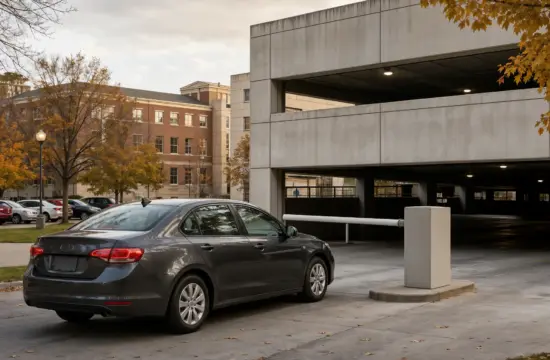
To get cars off the street, the City offers free overnight parking during declared emergencies at City-operated garages with gated sections, from 9:00 p.m. to 7:00 a.m.; enter earlier or leave later and you pay for the extra time.
Do not park on the top level (staff plow those areas), stay no longer than 48 hours, and remember metered sections are excluded — garage meters run around the clock. The Brittingham Park Shelter lot at 829 W. Washington Avenue is another free option during emergencies.
Fines and Towing: What a Winter Parking Mistake Costs
The City’s Fines and Towing page keeps the numbers simple:
- $20 for not following winter parking rules when there is no declared snow emergency.
- $60 when a snow emergency is declared.
- $115 towing fee, on top of the parking fine, if your vehicle is towed.
If your vehicle is towed, call Schmidt’s Auto at 608-257-0505 to find it. For questions about winter parking or tickets, contact Parking Enforcement at 608-266-4761 or parkingenforcement@cityofmadison.com.
Where to Park Off-Street in Winter
The simplest winter strategy is to get off the street. The City operates public garages and lots — Overture Center Garage, Capitol Square North Garage, State Street Capitol Garage, State Street Campus Garage, South Livingston Street Garage, and Wilson Street Garage, plus several surface lots.
City garages are open 24 hours and allow parking for up to 48 hours at posted hourly rates; lot policies vary. Monthly and annual passes are available for many garages and lots — worth considering if you would otherwise move your car every night of the season.
The City’s garage page also lists non-City options, including UW–Madison Transportation Services, Monona Terrace parking, and the Dane County Capitol Square South Ramp. Private lots are an option only with the owner’s permission, and never park where you block a driveway, ramp, or plow route.
Property Owners, Landlords, and Renters: The Snow You Must Clear
Winter parking rules are about more than parked cars. Property owners in Madison carry legal duties to keep sidewalks — and in some cases private parking areas — clear.
Public sidewalks. Owners are responsible for clearing snow and ice from public sidewalks along their property by noon the day after the snow stops: the full width, edge to edge, plus bordering curb ramps. Driveway aprons and private walks count too, and plows push snow back across driveways, so plan to re-clear after they pass.
The rule is Madison General Ordinance 10.28, explained on the City’s Sidewalks page.
Ice. Ice matters as much as snow. If ice will not come up, apply sand for traction. Salt only works above roughly 15°F, and over-salting is a real concern here — excess salt reaches Madison’s lakes, and the City can fine for it. Never shovel snow into the street; pile it in your yard or terrace.
Fines and city removal. The City does not warn before citing an uncleared sidewalk. A first-offense citation totals $124 with state fees; later offenses run $187, per the City’s sidewalk clearing fines page.
If the City removes the snow itself, the cost is added to the property tax bill as a special assessment.
Private walks, driveways, and parking areas. Public sidewalks fall under the sidewalk ordinance, but MGO 27.05(2)(d) separately requires owners to maintain private walks, driveways, and parking areas — the City can issue an Official Notice directing them cleared.
For apartment, office, and parking-lot owners, that means keeping private parking areas and their walkways passable all season.
Renters. Property owners are responsible for snow removal, but your lease decides who actually shovels. Read it before the first snowfall and confirm who clears the walks, who keeps your assigned space usable, and what to do on alternate-side nights if you park on the street. Landlords should put these duties in writing.
Before Winter Starts: A Quick Checklist
A little planning in October saves a ticket — or a tow — in January:
- Residents. Know whether you park inside or outside the Snow Emergency Zone. Sign up for the City’s text reminders and alerts, save the hotline (608-261-9111), and learn the odd-date/even-date rule before enforcement starts.
- Renters. Check your lease for snow and parking duties. If you park on the street, ask how your building handles alternate-side nights; if you rent a garage or assigned space, confirm it stays reachable after plows pass.
- Property owners and landlords. Line up snow removal early, including curb ramps and driveway aprons plows will re-block. Keep salt and sand on hand, use salt sparingly, and give tenants the rules in writing.
Madison’s winter parking program is under active review, and the 2026–27 season may differ from the 2025–26 trial. The City’s Winter page, the hotline, and the text and email alerts are the authoritative sources — bookmark them before the snow flies. This guide summarizes City of Madison pages verified in September 2026; the City’s published rules always control.